

Our latest newsletter (Spring 2020) is now out. Please have a read..
Divest, Disarm, Demilitarize
In May an international coalition organized by World BEYOND War will converge on Ottawa to say NO to CANSEC, Canada’s biggest arms bazaar.
Canadians
have been protesting CANSEC for years. It’s time to bring international
attention to Canada’s complicity in the global arms trade and endless wars. Activists,
grassroots organizers, and experts from around the world will be sharing
strategies and tactics for shutting down a weapons expo, divesting from war,
and converting to a peaceful, green, & just future.

Register to join us this May for nonviolent activism, skills training, art-making, panel presentations, rallying, and more, culminating in the #NoWar2020 Conference on May 29-30
Te Ao
Pritchard will
share lessons learned from the successful campaign to shut down New Zealand’s
weapons expo.
Siana Bangura from
Campaign Against Arms Trade (CAAT) UK will share her experience organizing
against DSEI, one of the world’s largest arms fairs.
Susi Snyder, author of
Don’t Bank on the Bomb, the only global report on the private financing of the
nuclear weapons industry, will lead a divestment training to talk about the
tools and tactics to cut off the flow of money to weapons companies.
Medea Benjamin,
CODEPINK Co-Founder, will talk about why war is not green, and why we need to
demilitarize to decarbonize, sharing expertise from her 40+ years of bold,
creative activism.
Doug Hewitt-White will be helping to
facilitate a discussion group on Divesting from the Military War Machine. We
will talk about the practicality and efficacy of refusing to pay for war.

The week will kick off with a live show by comedian-activist Lee Camp on May 24, followed by a free screenprinting workshop by the SAW Art + Protest Initiative on May 26, leading up to the protests at CANSEC on May 27 and 28, and concluding with the #NoWar2020 Conference on the 29th and 30th. For the full schedule, including many more events, visit the website here.
World Beyond War is partnering with a network of organizations, including Conscience Canada, Canadian Voice of Women for Peace and the Global Network Against Weapons and Nuclear Power in Space. View the full list of sponsors and endorsers.
Join us in Ottawa as we protest Canada’s largest weapons expo, and call for the conversion to a peace-based economy that works for all of us.
New podcast on Conscientious Objection to Military Taxation
Listen here to a discussion with Conscience Canada board members Doug Hewitt-White, Murray Lumley and Scott Albrecht. Scott Neigh from the Talking Radical Radio Show interviews them about CC, the history of conscientious objection in Canada, and about their work to establish a right to conscientious objection to military taxation.
The human game is a team sport
A Book Review by Mary Groh
FALTER by Bill McKibben (Holt and Co. 2019)
The metaphor of human life as a game functions aptly throughout this book. In Part 1, “The Size of the Board”, the author mentions widespread environmental problems we are increasingly familiar with: droughts, fires, pollution, floods, melting ice, rising seas, warming oceans, species extinction and more.
McKibben makes the accusation that “the most consequential lie in human history” was the banding together of Exxon, Chevron, Shell, Amoco and others to deny climate change. The effects of the burning of fossil fuels had been revealed by scientists and, although the oil magnates and company CEO’s recognized the evidence, they deliberately chose (in the 1980’s) to mount a disinformation campaign in the interests of their industry. Their efforts largely succeeded.
Part 2 “Leverage” shows how the novelist Ayn Rand pushed the ideology of libertarian-ism, and denigrated socialism in the minds of Americans, and most significantly, in the actions of their political leaders. The huge oil wealth of the Koch brothers funded efforts to influence political systems and keep the fossil fuel industry growing and unstoppable.
Another threat in the human game McKibben explores in Part 3. It is the unregulated development of AI. Experts in Silicon Valley and elsewhere seem addicted to pushing their technology ever further into the realm of human agency but without values added. Therapies that can rid a fetus of the gene for, say, cystic fibrosis he considers a human advance; but letting parents produce designer babies is not. One negative effect would be more inequality among people. As with unregulated greenhouse gas emissions, there could be runaway effects beyond human control.
In Part 4 the book proposes two ways to “help us keep global warming and technological mania within some limits, and keep the human race recognizable, even robust.” The author enthusiastically promotes solar panel technology, recounting his visits to remote African villages where solar power provides electricity to people in countries that cannot afford to connect them to the grid.
The second way discussed is of particular interest to peace activists: non-violent mass protests. These have the power to bring about change (think Gandhi, Martin Luther King movements). Earth Day 1970, when 20 million Americans joined in demonstrations, led eventually to Nixon having to sign significant environmental laws still in effect today. The protests against the Keystone pipeline (2011) reversed the leverage of the fossil fuel industry. The book is recent enough to include Greta Thunberg and the school strikes, (but not recent enough to refer to the Hong Kong pro-democracy demonstrations).
As a war tax resister I was fascinated with the quote from Thoreau, the New Englander who refused to pay the poll tax. He wrote in 1849 as the Civil War was brewing, “If a thousand men were not to pay their tax bills this year, that would not be a violent and bloody measure . . . [but] in fact, the definition of a peaceable revolution.”
This book brings so much pertinent information together in just 244 pages in a readable and persuasive style. “The human game is a team sport.” McKibben makes the reader want to join the team of environmental and peace activists.
“It is nonviolence or non-existence”
Some of us would remember exactly where we were on the day 50 years back when Martin Luther King Jr. was murdered so hideously. Very few “survive” being killed in the way that Martin Luther King has done. The civil rights movement and the struggle against racism are forever linked to his name, his words and his deeds. As we mark the 50th anniversary of his death it is of high value to have this collective reflection in order to look more deeply into what his legacy means, and may mean, in the 21 Century.
Even though his name may be most strongly linked to the fight against racial segregation, his opposition to war and encouragement of non-violence remain of great inspiration. . . . .
Read all of Ingeborg Breines’ opinion piece in the latest IPB newsletter
It was the bankers who won
by Eric Unger
HAVE YOU watched the movie, Hacksaw Ridge? It’s worth a look, I think.
Having viewed this film about an American WWII conscientious objector I wondered if Canada had had a similar soldier who refused to kill yet served in war. Then while in the doctor’s waiting room the other day I came upon this short article here in Reader’s Digest about a Korean War veteran and CO.
This excerpt from the story really caught my eye:
After Pelletier was honourably discharged on August 13, 1953… He married Rosaline in the spring of 1964 and they settled in Sherbrooke, Quebec, and had four children: three sons and a daughter. When the kids were young, Pelletier brought them to Remembrance Day ceremonies and gave them mock parachute lessons in the basement, but he told them very little about the war. This dismayed their second oldest, Louis-Marie, who, as a child, was anxious for details of his father’s courageous exploits in Korea. One day, in a bid to find out more, he asked his dad which side had been victorious. “We wanted so much for him to tell us it was him—that he had won the war,” says Louis-Marie, laughing. “But he told us it was the bankers who’d really won. [emphasis mine] What a boring answer! Still, he wasn’t wrong.”
No to NATO — Yes to Peace
News Flash
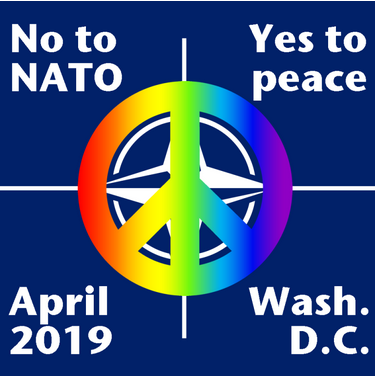 The North Atlantic Treaty Organization (NATO) plans a summit, or at least a “celebration” in Washington, D.C., April 4, 2019, to mark 70 years since its creation on April 4, 1949.
A peace festival is being planned to advocate the abolition of NATO, the promotion of peace, the redirection of resources to human and environmental needs, the demilitarization of our cultures, and the commemoration of Martin Luther King Jr.’s speech against war on April 4, 1967, as well as his assassination on April 4, 1968.
Learn more and get involved at http://notonato.org
Round Table Discussions on Women, Peace & Security
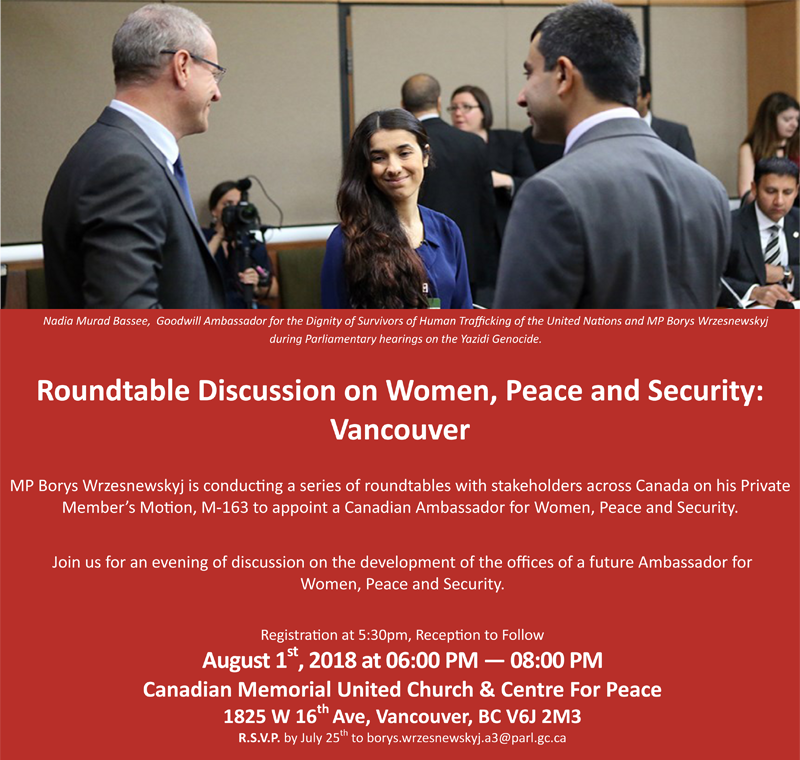
MP Borys Wrzesnewskyj is conducting a series of round tables with stakeholders across Canada on his Private Member’s Motion, M-163, to appoint a Canadian Ambassador for Women, Peace & Security.
The next round tables are to be held in Montreal and Halifax in late August. For more information, please contact Isabella McKenna, Parliamentary Intern, (613) 947-5000 or borys.wrzesnewskyj.a3@parl.gc.ca
Military Exploits Vulnerable Teenagers
A new report just released claims NATO armed forces in their treatment of teenage recruits “may violate international law”.
The report reveals:
- Physical, psychological and sexual abuse is endemic;
- Consent arrangements are legally inadequate;
- Recruitment and training practices “exploit young people”.
The report, Why 18 Matters, by the human rights group Child Soldiers International, examines recruitment and training practices of economically developed states, drawing on over 200 academic and official sources and the testimony of recruits. It shows how nations capitalise on the social, economic and psychological vulnerabilities of disadvantaged adolescents to meet recruiting targets. The authors claim these states may be violating their commitments under international law.
Young people considering a military career face misinformation, weak consent arrangements, routine ill-treatment during training, and an unacceptable risk of mental health problems as a result of joining too young, according to this new report into the enlistment of teenagers.
Examining the situation in Canada the report’s researchers highlighted “the deep-seated hierarchical nature of military culture, and the degree to which emphasis on the values of obedience, conformity and respect for superiors can lead to abuses of power, [and] the susceptibility of junior members to negative social influence”. In Canada, Germany, the UK and the US there is an increased risk of violent behaviour among young recruits.
Child Soldiers International is an international human rights organisation established in 1998 to end the recruitment, use and exploitation of children below the age of 18 by armed forces and military groups worldwide. It campaigns for a global minimum enlistment age of at least 18 years. Read more at http://www.child-soldiers.org.
NEWS FLASH
The United Nations has just recently decided to postpone the UN Conference on Nuclear Disarmament scheduled to take place in New York from May 14-16, 2018. New dates for the UN conference have not yet been set.
As a result the Count the Nuclear Weapons Money, a 7-day action highlighting the colossal nuclear weapons budget and what this money could instead support, will be postponed until UN Disarmament Week , October 24-30, 2018.