
Below you’ll find Richard Sandbrook’s Globe & Mail op-ed on nonviolent defence as well as letters published commenting on the piece. Hopefully this will be one of many more such discussions. Note: Richard’s book, The Citizens Guide to Nonviolent Defence, will be available in November, 2026.
With talk of a hypothetical American invasion, Canadians should think about nonviolent resistance: https://www.theglobeandmail.com/opinion/article-hypothetical-american-invasion-canadians-should-nonviolent-resistance/
Richard Sandbrook is an emeritus professor of political science at the University of Toronto and vice-president of Science for Peace. He is the author of the forthcoming book, The Citizen’s Guide to Nonviolent Defence: How Canadians Can Deter Invasions, Defeat Tyranny and Build Democracy.
Prime Minister Mark Carney claimed, in an interview on Sept. 23, that it would be “irresponsible” for Canada not to prepare for the “extreme tail risk” of U.S. military action against Canada. He refused, however, to provide any details.
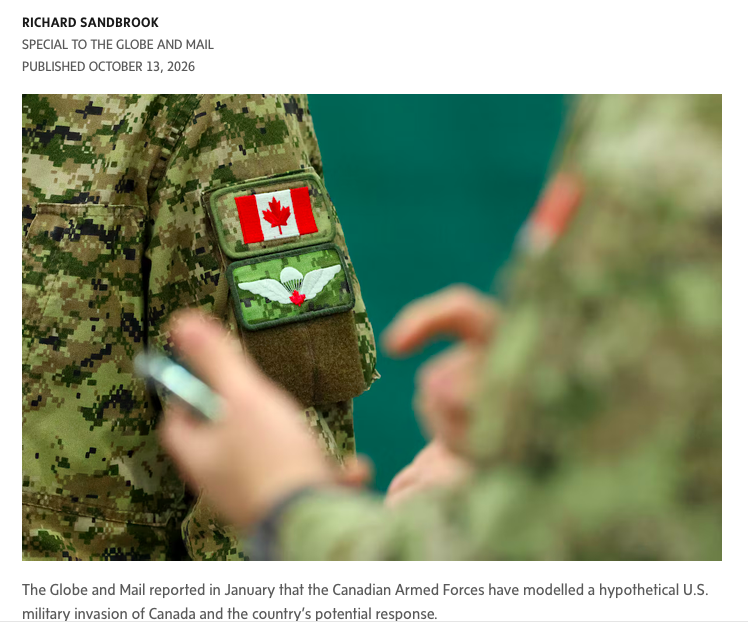
How would Canada respond to an invasion? A Globe and Mail article from Jan. 20 provides the answer. The military has apparently developed a contingency model for the unlikely event of a U.S. invasion. Canada would mount a military defence, but it would be breached within two to seven days. Resistance would then shift to an insurgency on the Afghan model, intended to impose high costs on the invading force. Insurgents would engage in hit-and-run tactics, sabotage, ambushes and planting improvised explosive devices.
Chief of Defence Staff General Jennie Carignan authorized a mobilization plan for a supplementary volunteer reserve force that would eventually number 300,000, according to reports in October, 2025. The volunteers would receive training in basic emergency and combat skills such as the use of firearms, communication systems and drones.
Carney prepared for risk that Trump might order military action against Canada, report says
Presumably, this force would form the backbone of guerrilla warfare.
This contingency planning takes us in the wrong direction. First, modern warfare is enormously destructive, as the Ukraine war attests. Aside from the devastating impact on Canadian cities, the violent confrontation would make it difficult for Canada’s friends and allies in the United States to organize a powerful internal resistance. Such action might be construed as treasonous.
Second, Canadians possess neither the culture nor history of insurgent struggle, unlike the Afghans whose example is cited in the Globe’s report. What proportion of the Canadian public would become guerrillas, undertaking ambushes and hit-and-run raids? Even if such a guerrilla force did emerge, its actions would justify, in the enemy’s eyes, a repressive response.
The alternative strategy is hiding in plain sight: nonviolent civilian defence in the cities of southern Canada.
Nonviolent defence offers Canada a potentially efficient and effective deterrence and defence, at a relatively low cost in terms of casualties and infrastructural damage. The case for civilian defence is pragmatic.
What is nonviolent defence, and how would it work? It is a strategy of deterrence and resistance in which unarmed civilians play a major role, either alone or in co-ordination with the armed forces. The civilian volunteers employ their training in nonviolent methods to make their country ungovernable by the occupier and to undermine the pillars of support on which the invader depends.
Civilian defence does not mean the displacement of the Canadian Armed Forces, though it does require that the two forces, obeying conflicting logics, co-ordinate their activities. Joint deployment demands geographical separation. Nonviolent defence would operate in the populated southern band of Canada; the CAF would be responsible for security in the remainder of Canada, in areas in which population is too limited and dispersed to allow for civilian defence. The armed forces would also provide services to the civilian defenders, including intelligence and protection from cyber-attacks and drone attacks.
The volunteer civilian force would be inexpensive, so the reduced role for the military would allow for smaller defence budgets: not the 5 per cent of GDP planned for by 2035, but perhaps no increase above the current 2 per cent. Other priorities could then be funded.
Is it realistic to expect unarmed Canadians to confront a heavily armed invading force? Yes, though obviously, it will take courage. It has often happened elsewhere. And in an Environics poll in April, 55 per cent of a sample of 1,800 Canadians stated they would resist an invasion or occupation. Fifteen per cent would resist with armed force. Yet 40 per cent (or as many as 14 million Canadian adults) said they would resist in a nonviolent manner.
Even if only half or a quarter of this number showed up, it constitutes a substantial force. But people need to learn how to resist non-violently.
Why not train the new supplementary force in the strategy and tactics of civilian defence and empower its recruits to return to their communities to train volunteers in local chapters? If successful, nonviolent defence would never need to be used. Its existence would act as a powerful deterrent. An additional benefit would be the rebuilding of networks of trust and co-operation at the local level. Nonviolent defence is inherently democratic.
Letters October 19, 2026
Re “With talk of a hypothetical American invasion, Canadians should think about nonviolent resistance” (Oct. 13): As a people and a government, we should plan for the defence of Canada in the face of invasion or authoritarian takeover, even though it is an “extreme tail risk,” in our Prime Minister’s words.
Planning a strategic nonviolent defence of Canada opens up so many possibilities for meaningful protection of our people and country than a solely military response. It is a deeply democratic and inclusive approach and could release massive energies for nation-building, even if the plan is never activated.
As this is a matter of sovereignty, we should engage in nation-to-nation dialogue with Indigenous nations. Let’s put a nonviolent defence force on top of the list of our country’s nation-building projects.
Many of us may be willing to die to protect Canada, but not to kill.
Joel Klassen Toronto
The call for nonviolent resistance seems like the typical and politically correct “nice” Canadian approach to a potential invasion. I believe it is only half the equation.
As historical resistance movements in places such as France, the Netherlands, Poland, Vietnam and Afghanistan have demonstrated, effective ones also involve well-planned and executed violence against an occupying force.
By all means promote nonviolent resistance, but if eventual freedom is the goal, we should also plan for some violence.
David Morgan Ottawa
Letters October 20, 2026
Re “With talk of a hypothetical American invasion, Canadians should think about nonviolent resistance”(Oct. 13): “Us versus them” thinking leads to violence; Donald Trump’s rise is clear testimony to that. It’s our job to build on the “model of non-violence, restraint and egalitarianism” that John Ralston Saul described in his 2010 book on Louis-Hippolyte Lafontaine and Robert Baldwin.
As he explained in a 2010 interview with then-journalist Evan Solomon: “Canada was created intellectually, intentionally, emotionally on purpose, to be a place of restraint, and by being a place of restraint it meant that not just French and English could live together, but all sorts of people could live together.”
Now, too, the forces of disunity, within and outside our borders, threaten our well-being. Our response should be grounded in awareness and appreciation of our interconnectedness.
Jan Slakov Texada Island, B.C.
Canada should prepare creatively for whatever may come, whether from the United States or another hostile actor.
Political scientist Erica Chenoweth catalogued more than a century of resistance to coups and invasions. Mainly nonviolent resistance campaigns worked about half the time, while violent campaigns worked about one-quarter of the time.
Non-violence allows an entire population to be involved and maintains a more democratic order once an invasion is repelled. It is not without risk, nor is there a guarantee of success. But violence has a higher risk of casualties and a lower chance of success.
I would caution about co-ordinating a nonviolent resistance too closely with the military. Disciplined non-violence maintains credibility and invites defections from the opposition, which are some keys to success.
All Canadians can have a role preparing to defend Canada non-violently.
Scott Albrecht Kitchener, Ont.